
Somewhere between buying your fourth moisturiser that did not quite work and reading your third conflicting skincare guide, you have probably wondered — do I actually know my skin type? Not what the quiz at a skincare counter told you three years ago. Your actual skin type, right now, in Indian weather. Because it turns out this is one of those things most people get slightly wrong, and it explains a surprising number of skincare problems that seem completely unrelated.
You Have Probably Been Using the Wrong Products
Let me guess. You have spent real money on a moisturiser that someone recommended — maybe on YouTube, maybe a friend who swore by it — and it just did not work. Either your face felt greasy by 10am or you were applying it three times a day and still felt like sandpaper by evening.
That is not a bad product. That is a product that was made for someone else's skin.
And it almost always comes down to one thing: most people genuinely do not know their skin type. Not really. They have a rough idea — "I think I have oily skin" — based on something they read once, or what a sales person at a Nykaa counter told them five years ago. But identifying skin type properly, especially in India, is actually trickier than most people realise.
Here is why — and more importantly, how to get it right.
Why India Makes This Genuinely Harder
Most skin type guides you find online are written for Western climates. One season, predictable humidity, central heating. India does not work like that.
Think about what your skin goes through in a single year in, say, Mumbai or Delhi. Summer heat that pushes sebum production into overdrive. Monsoon humidity that makes everything feel heavier. Dry winter air — especially in north India — that strips moisture. And then three months of sitting in AC rooms that are basically dehumidifiers pointed at your face.
Your skin is responding to all of this. Which means the "oily" you diagnosed in June might become "dry" in December. Same skin, different season, completely different behaviour. This is why so many Indians end up with multiple moisturisers — one for summer, one for winter — without ever understanding why.
The other complicating factor is that Indian skin, particularly South Asian skin, tends to have higher melanin density and often more reactive sebaceous glands. This means oiliness can look different on darker skin tones than the standard descriptions suggest. The classic "shiny T-zone" looks different at different skin tones. This matters when you are trying to self-diagnose.
What the Four Types Actually Feel Like — Not Just Look Like
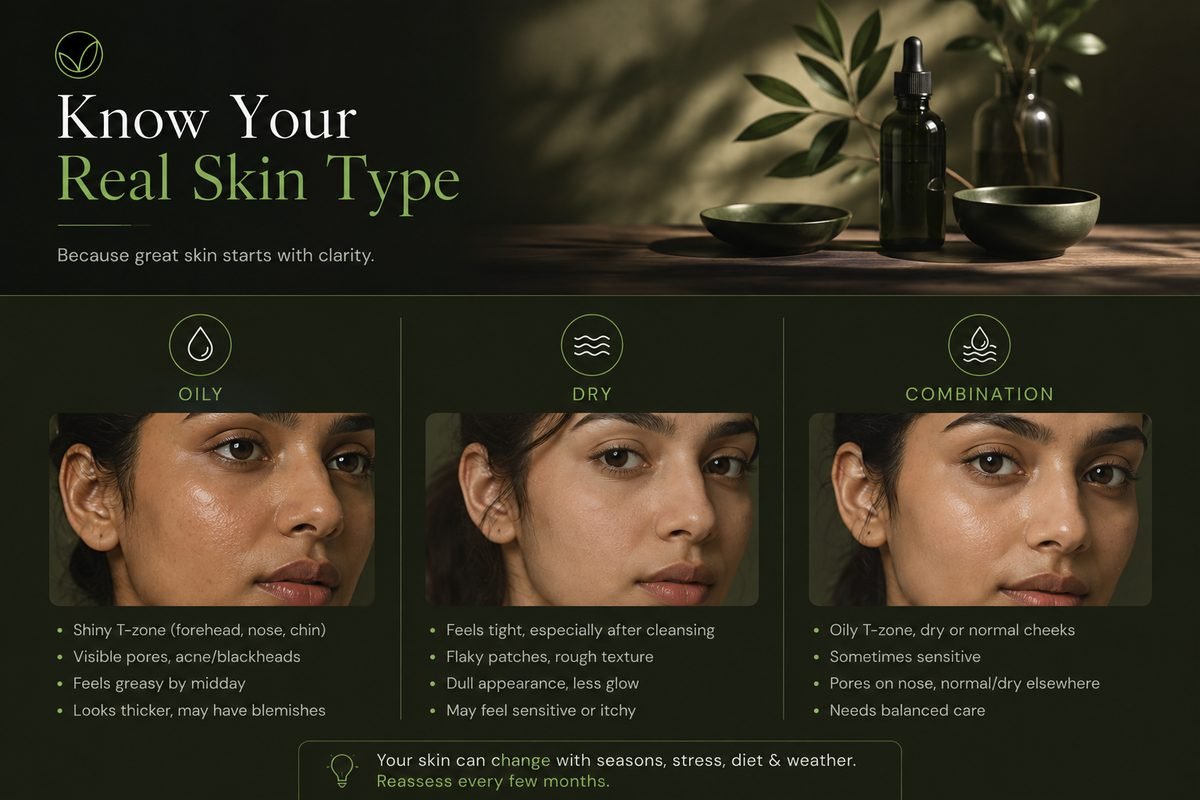
Forget what you think you know for a second. The descriptions below are based on how skin feels — not just how it looks in a mirror — because Indian skin can appear the same while behaving very differently underneath.
Oily Skin
You wake up and your face is shiny. Not glowing — shiny. Like someone pressed cling film to your forehead. By midday, even after washing your face in the morning, the shine is back. Your pores are visible, particularly around the nose and chin. Makeup slides off. Blotting papers come back completely soaked.
In Indian summers, this can feel overwhelming. The good news — and nobody tells oily-skin people this enough — is that oily skin ages slower. The oil is lubricating. But you still need the right products or you are going to be dealing with blackheads and clogged pores constantly.
Dry Skin
Dry skin feels tight. After you wash your face, you have maybe twenty minutes before it starts feeling uncomfortable — almost like your face is a size too small. Flakiness around the nose and cheeks is common. You might notice your skin looks dull even after moisturising. Foundation settles into fine lines.
In Indian winters, dry skin becomes a real problem. The air is drier, indoor heating (or fans running all night) pulls more moisture out. A lot of people with dry skin think their skin is "normal" in summer and only notice the issue in winter — but the baseline is the same. The summer humidity was masking it.
Combination Skin
This is, genuinely, the most common skin type in India. And it is the most confusing one because it feels like your skin cannot make up its mind.
T-zone — forehead, nose, chin — is oily. Cheeks are normal or even dry. You might have visible pores on your nose but flakiness near your jaw. Finding products that work without making one area worse while helping the other is the constant balancing act of combination skin life.
In Indian weather, combination skin shifts dramatically with seasons. Monsoon makes the T-zone more oily. Winter makes the cheeks drier. You are essentially managing two different skin types on one face.
Sensitive Skin
Sensitive skin is a bit different — it is less about oil production and more about reactivity. New products cause redness. Certain ingredients sting. Your skin flushes easily. It might also be dry or combination alongside being sensitive, which adds another layer.
This is worth knowing separately because sensitive skin changes which ingredients you can use, not just which textures.
The Bare Face Test — Do This Tonight
This is the most reliable way to know, and you can do it right now. Or tonight. Takes about an hour total but most of that is just waiting.
Wash your face with a gentle cleanser — nothing harsh, nothing with a strong fragrance. Pat dry. Do not apply anything else. No toner, no serum, no moisturiser. Nothing. Then go about your evening normally for 60 minutes.
After an hour, go to a well-lit room and look at your skin. Not a filtered mirror. A good light.
If your entire face is shining — oily. If it feels tight and looks dull — dry. Shiny forehead and nose but normal or even slightly rough cheeks — combination. If it is red, irritated or stinging during that hour — sensitive.
Do this test in your normal environment. Not after a day at the beach. Not after spending six hours in an AC conference room. A regular evening at home gives you the most useful reading.
If you want to go deeper — because reading the signs yourself can sometimes lead to second-guessing — GlowAF has a free two-minute skin type quiz at glowaf.online/quiz.html that walks you through it with specific questions built around Indian skin and Indian climate conditions.
Why Your Skin Type Seems to Change — And What to Do About It
Here is something that confuses a lot of people: your skin type does not really change. But your skin behaviour does. Constantly.
What happens is that external factors — weather, diet, stress, hormones, the products you are using — change how your skin expresses its natural type. An oily skin person in a dry Delhi January might not produce as much oil as usual. That does not make them dry-skinned. Their baseline is still oily. They just need slightly heavier moisturising in winter while still using an oil-control cleanser.
The practical implication: instead of switching your entire routine seasonally, adjust it. Keep your cleanser and toner consistent with your actual skin type. Layer products differently. Add a heavier moisturiser in winter. Drop to a lighter one in summer. This is more effective than buying a completely different set of products every six months.
Hormonal changes matter too. Your skin in your mid-20s is not the same as your skin at 30. Pregnancy, thyroid issues, PCOS — these all affect sebum production. If your skin has changed significantly and nothing in your routine or environment explains it, that is worth noting and possibly mentioning to a dermatologist.
The Mistakes People Make After Finding Out Their Skin Type
Knowing your skin type is the first step. The second — and where most people go wrong — is overcorrecting.
Oily skin people often go too far with oil control. They use harsh foaming cleansers, skip moisturiser entirely because "why would I add more oil," and end up with skin that is stripped and confused and producing even more oil to compensate. The skin is not the enemy. It is overreacting because something is off in the routine.
Dry skin people sometimes stack so many rich products that their skin cannot absorb them properly. They layer a heavy cream over a heavy serum over a thick toner and wonder why their skin still feels uncomfortable. Dry skin needs the right ingredients — hyaluronic acid, ceramides, glycerin — not necessarily the richest textures.
Combination skin people tend to treat both parts of their face identically, usually for the oilier part, and then wonder why their cheeks feel constantly parched. Using a gel cleanser on the T-zone and a slightly creamier one on the cheeks sounds fussy but makes a real difference. Or using a lighter moisturiser on the T-zone and a richer one on the cheeks — applied separately.
And almost everyone — regardless of skin type — underestimates how much hydration matters. Oily skin is not the same as hydrated skin. You can have an excessively oily face that is still dehydrated underneath. This is incredibly common in India, especially with AC exposure, and it is why some oily-skin people find that adding a hyaluronic acid serum actually reduces their oiliness over time. The skin stops panicking.
Your skin in June in Delhi is not the same skin you had in January. Same person, completely different behaviour. This is why the ₹800 serum that worked in winter suddenly felt like face glue in summer.
Key Takeaways
- Use the bare face test — wash, wait 60 minutes, no products — to get the most accurate read on your skin type
- Combination skin is the most common type in India, especially in cities with mixed weather patterns
- Indian AC rooms and monsoon humidity can make your skin behave like a completely different type seasonally
- Oily skin can still be dehydrated — shine does not always mean your skin does not need moisture
- Reassess your skin type every 3 to 4 months — your routine should shift with the seasons
- Take GlowAF's free skin type quiz at glowaf.online/quiz.html for a personalised breakdown in under 2 minutes
Ready to buy?Not sure about your skin type? Take GlowAF's free two-minute skin quiz — built specifically for Indian skin and Indian weather conditions.
See Full Guide →