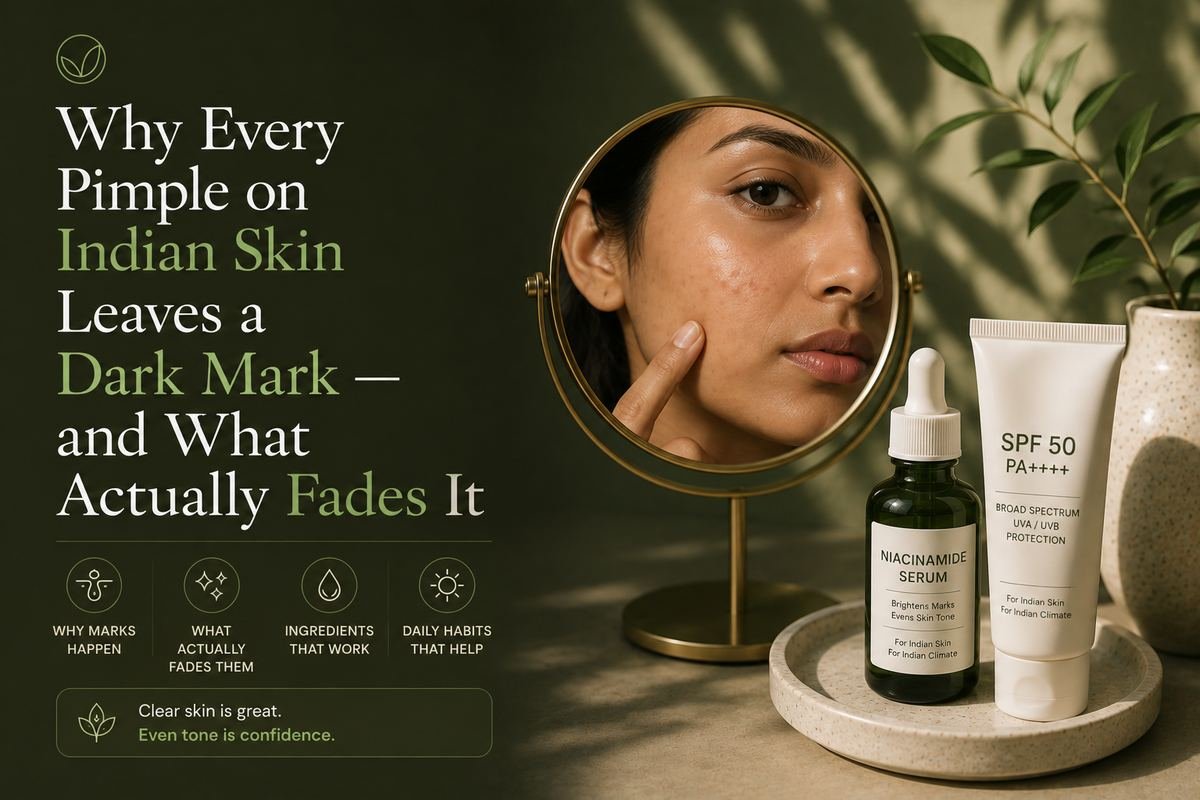
You clear a pimple. The redness goes away. But where the pimple was, there is now a brown or dark patch that refuses to leave. Weeks pass. You try covering it with foundation. Months later it is still there, maybe a little lighter, but unmistakably present. Nothing is wrong with your skin. This is one of the most common experiences among Indian skincare users, and it has a specific name, a specific mechanism, and a specific set of things that actually help.
You clear a pimple. The redness goes away. But where the pimple was, there is now a brown or dark patch that refuses to leave. Weeks pass. You try covering it with foundation. Months later it is still there, maybe a little lighter, but unmistakably present. Nothing is wrong with your skin. This is one of the most common experiences among Indian skincare users, and it has a specific name, a specific mechanism, and a specific set of things that actually help.
What the dark mark actually is, and what it is not
Most people assume dark marks after pimples are scars. They are not. A scar involves structural damage to the dermis, the deeper layer of skin. That produces textural changes: the indented marks that remain sunken after acne heals. A flat dark mark after a pimple is different. It is purely a pigmentation issue, excess melanin deposited in the skin during the inflammatory process. The skin read the inflammation as a threat, activated its melanin-producing cells as a defensive response, and left behind more pigment than it needed. The skin structure underneath is completely intact. There is no damage, just colour.
Why Indian skin is more prone to PIH
Melanin is produced by cells called melanocytes. They respond to UV, heat, hormones and inflammation. Indian skin (Fitzpatrick types IV, V and VI) has the same number of melanocytes as lighter skin, but each melanocyte is more active, it produces larger amounts of melanin per stimulus. This is not a defect. Higher melanin production provides natural protection from UV in high-UV environments like the Indian subcontinent. The same melanin density that helps protect skin from sun damage also means any inflammatory trigger, a pimple, a scratch, even friction from rubbing skin too hard, produces a more intense pigmentation response.
Things that make PIH worse
Sun exposure without SPF is the biggest factor. UV rays directly stimulate melanocytes to produce more melanin. An existing PIH mark exposed to daily sun without protection will keep deepening even as you use brightening serums simultaneously.
Picking or squeezing pimples causes significantly more inflammation than the pimple itself, producing more severe PIH that lasts longer. Scrubbing with face scrubs or rough washcloths creates friction-induced inflammation, triggering more melanin. Many people scrub dark marks trying to physically remove them. This consistently makes them worse.
What actually fades PIH
Vitamin C inhibits tyrosinase, the enzyme that converts tyrosine to melanin. By interrupting melanin production at the source, it prevents new pigment from being deposited. Minimalist 10% Advanced Vitamin C Serum (Rs.282) is one of the most affordable stable options in India. Chemist At Play 10% Vitamin C Serum (Rs.259) adds lactic acid for additional surface turnover benefit.
Niacinamide reduces the transfer of melanin from melanocytes to keratinocytes. This is a different mechanism from vitamin C, which is why they work well together. DOT and KEY 10% Vitamin C Plus E Serum (Rs.499) combines both vitamin C and niacinamide in a single product.
SPF 50 PA++++ is not optional, it is half the treatment. UV drives melanin production. Without SPF, every morning undoes brightening progress. Use GlowAF's SPF calculator to confirm you are applying the correct amount. The Derma Co 1% Hyaluronic Aqua Gel Sunscreen SPF 50 PA++++ (Rs.239) is lightweight and non-comedogenic, suitable for acne-prone skin dealing with PIH simultaneously.
How vitamin C works on dark marks specifically
Vitamin C works upstream. It does not bleach or chemically remove existing pigment. It stops the melanocyte from producing more, and as skin naturally turns over (shedding old cells every 28 to 40 days), the pigmented cells are replaced by unpigmented ones. The result is gradual lightening rather than sudden change. For this reason, consistent daily use over a minimum of 8 weeks is necessary before visible results appear. Foxtale 10% Vitamin C-Glutathione Brightening Serum (Rs.567) adds glutathione alongside vitamin C, which works on a different melanin pathway and is useful for stubborn or multi-layered PIH. The Derma Co 15% Vitamin C Serum (Rs.704) is worth considering once skin has adjusted to 10 percent without irritation, particularly for older or more stubborn marks.
For a complete personalised routine that addresses your skin type and PIH severity, GlowAF's free skin consultation builds a step-by-step plan for Indian skin. Also check the GlowAF Vitamin C serum guide for all 30 verified serums ranked by price and skin type.
Realistic timeline for Indian skin
- Weeks 2 to 4: New pimple marks may stop deepening. Existing marks continue unchanged visually.
- Weeks 4 to 8: Light recent marks begin to visibly lighten by 20 to 30 percent.
- Weeks 8 to 12: More significant fading. Fresh marks largely cleared. Older marks noticeably lighter.
- Months 3 to 6: Older, deeper marks from years of acne showing consistent fading.
The same melanin density that protects Indian skin from sunburn also means any inflammation, including a pimple, leaves a more intense, longer-lasting dark mark.
Key Takeaways
- Dark marks after pimples are PIH, excess melanin, not scarring. They can be faded.
- Indian skin produces more intense melanin responses to inflammation, making PIH more common and darker.
- Vitamin C inhibits melanin production. Niacinamide reduces melanin transfer. SPF prevents UV from deepening marks.
- All three together produce the most consistent results. None works well without daily SPF.
- Realistic fading timeline for recent marks: 8 to 12 weeks. Older marks: 3 to 6 months.
The same melanin density that protects Indian skin from sunburn also means any inflammation, including a pimple, leaves a more intense, longer-lasting dark mark.
Key Takeaways
- Dark marks after pimples are PIH, excess melanin, not scarring. They can be faded.
- Indian skin produces more intense melanin responses to inflammation, making PIH more common and darker.
- Vitamin C inhibits melanin production. Niacinamide reduces melanin transfer. SPF prevents UV from deepening marks.
- All three together produce the most consistent results. None works well without daily SPF.
- Realistic fading timeline for recent marks: 8 to 12 weeks. Older marks: 3 to 6 months.