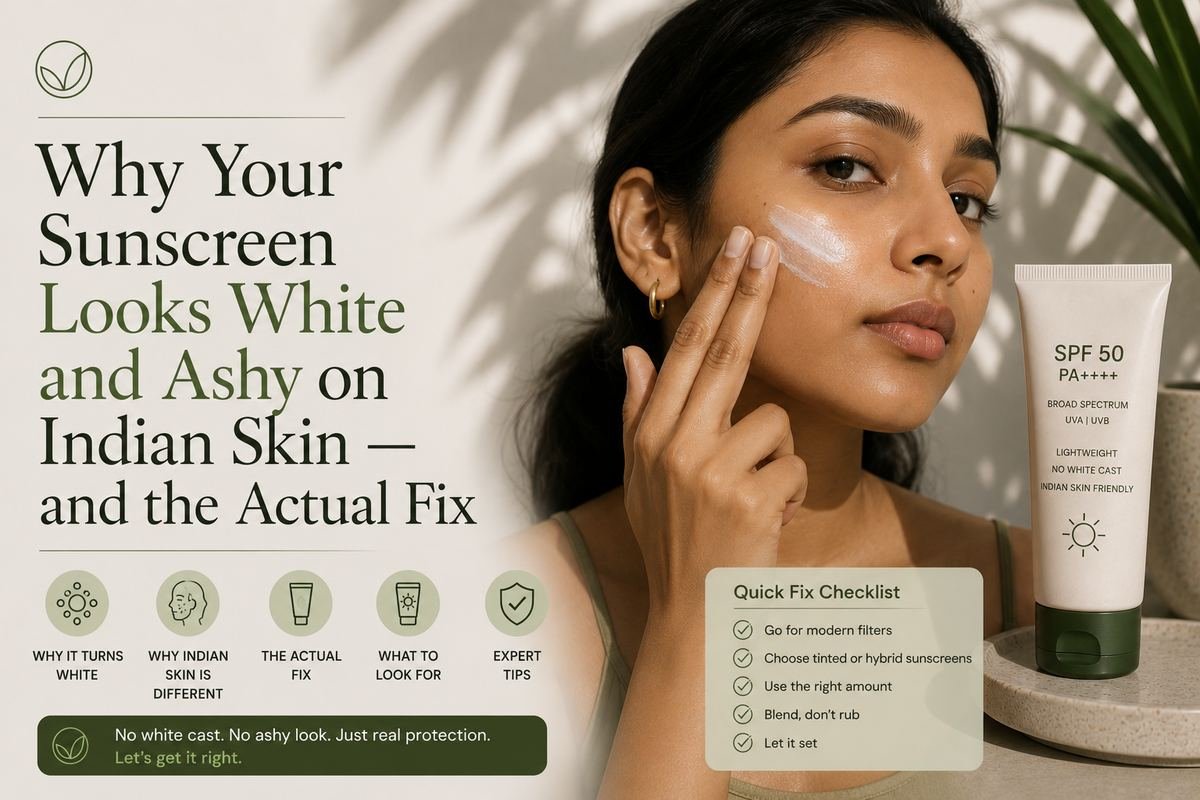
You applied the sunscreen the packaging told you to use. You looked in the mirror. Your face was grey. Or chalky. Or visibly white in patches. You tried blending harder. The product smeared but did not disappear. You wiped some off. It made the coverage patchy. You gave up on sunscreen for the next three weeks. This scenario plays out every day for millions of Indian skincare users, and it is the primary reason many Indian consumers skip sun protection entirely despite knowing they should not.
You applied the sunscreen the packaging told you to use. You looked in the mirror. Your face was grey. Or chalky. Or visibly white in patches. You tried blending harder. The product smeared but did not disappear. You wiped some off. It made the coverage patchy. You gave up on sunscreen for the next three weeks. This scenario plays out every day for millions of Indian skincare users, and it is the primary reason many Indian consumers skip sun protection entirely despite knowing they should not.
Why white cast happens in the first place
Sunscreens protect against UV rays through two fundamentally different mechanisms. Mineral sunscreens use zinc oxide and titanium dioxide as UV filters. These are naturally white inorganic particles that physically sit on the skin surface and reflect or scatter UV rays. Because they are white, they create a visible white or grey film on the skin, especially when applied in the quantities needed for adequate protection. Chemical sunscreens use organic molecules (avobenzone, octinoxate, Tinosorb S, Tinosorb M) that absorb UV energy and convert it into heat. Because these molecules absorb into the skin, they leave no visible residue. The white cast problem is inherently a mineral sunscreen problem.
Why Indian skin shows it more than lighter skin tones
Indian skin tones span Fitzpatrick types III through VI, from medium to very dark. The contrast between a white zinc oxide film and medium-to-dark Indian skin is dramatically higher than the contrast between that same film and a fair Fitzpatrick I or II skin tone where it is barely visible. This is why so much sunscreen advice from Western skincare communities does not translate to Indian skin. A sunscreen that blends in fine on a European reviewer may look like stage makeup on Indian skin. The formula itself is the problem, not your application technique.
The two types of sunscreen and how each behaves on Indian skin
Mineral sunscreens: Always have some degree of white cast on Indian skin at SPF 50 concentration unless nano-sized zinc oxide particles are used. No amount of extra blending eliminates the cast from a standard mineral sunscreen on medium or dark Indian skin. Tinted mineral sunscreens reduce the issue by adding pigment to offset the white.
Chemical sunscreens: No white cast. They absorb into the skin and leave no visible film. Some chemical filters can irritate sensitive Indian skin, particularly avobenzone at high concentrations. Modern Indian brands have largely reformulated around newer, more skin-compatible filters like Tinosorb S and Uvinul T150.
The actual fixes for white cast on Indian skin
Switch to a chemical or hybrid sunscreen. The Derma Co 1% Hyaluronic Aqua Gel Sunscreen SPF 50 PA++++ (Rs.239) is one of the most recommended zero-white-cast options in India. It is a gel formula that absorbs completely on most Indian skin tones. Minimalist Hydrating Face Sunscreen SPF 50 PA++++ (Rs.249) combines sun protection with niacinamide in a transparent finish.
Try a tinted sunscreen. Lakme Tinted Sunscreen SPF 50 PA++++ with Niacinamide (Rs.269) adds a subtle tint that offsets the grey from mineral filters on light to medium Indian skin. DermDoc Ultra Violet Brightening Tinted Sunscreen (Rs.499) uses a purple-tinted formula that counteracts the yellow-grey appearance on medium-deep Indian skin.
For oily Indian skin specifically: WishCare Niacinamide Oil Balance Fluid Sunscreen SPF 50 PA++++ (Rs.379) provides matte finish and no white cast. Deconstruct Gel Sunscreen SPF 50 PA++++ (Rs.331) uses new-generation photostable UV filters designed for oily Indian skin.
Application technique that genuinely helps
- Apply on slightly damp skin after moisturiser has partially absorbed. Dry skin makes sunscreen sit more visibly on the surface.
- Apply in two thin layers. Half the dose, wait 30 seconds, then the second half. This visibly reduces white cast without reducing protection.
- Pat rather than rub. Rubbing aerates the product and makes white particles more visible.
- Wait 60 to 90 seconds before applying powder or makeup.
Use GlowAF's SPF calculator to confirm you are applying the correct quantity. The correct amount of a good formula gives visible protection without the ashy look. See the full sunscreen guide for India for all 32 verified options ranked by skin type and formula.
What PA++++ means for Indian skin
PA++++ is the highest UVA protection rating available over the counter. UVA causes tanning, dark spots, melasma and premature ageing, the four most prevalent sun-related skin concerns among Indian consumers. For Indian skin, getting PA++++ should be considered as important as SPF 50. Never buy a sunscreen for Indian skin that has PA++ or lower , it is inadequate for year-round Indian UV conditions.
A sunscreen that blends invisibly on fair Western skin can look like grey paste on medium-to-dark Indian skin. The formula itself is the problem, not the application technique.
Key Takeaways
- White cast is a mineral sunscreen problem, zinc oxide and titanium dioxide are naturally white and visible on Indian skin tones.
- Chemical sunscreens have essentially no white cast and are often the better choice for medium-to-dark Indian skin.
- Tinted sunscreens reduce white cast by counteracting the grey with warmth and light coverage.
- Applying in two thin layers rather than one thick application visibly reduces white cast without reducing protection.
- PA++++ is equally important as SPF 50 for Indian skin and should never be compromised.
A sunscreen that blends invisibly on fair Western skin can look like grey paste on medium-to-dark Indian skin. The formula itself is the problem, not the application technique.
Key Takeaways
- White cast is a mineral sunscreen problem. Zinc oxide and titanium dioxide are white and visible on Indian skin.
- Chemical sunscreens have essentially no white cast and are often the better choice for Indian skin.
- Tinted sunscreens reduce white cast by counteracting the grey with warmth and light coverage.
- Applying in two thin layers rather than one thick application visibly reduces white cast without reducing protection.
- PA++++ is equally important as SPF 50 for Indian skin and should never be compromised.