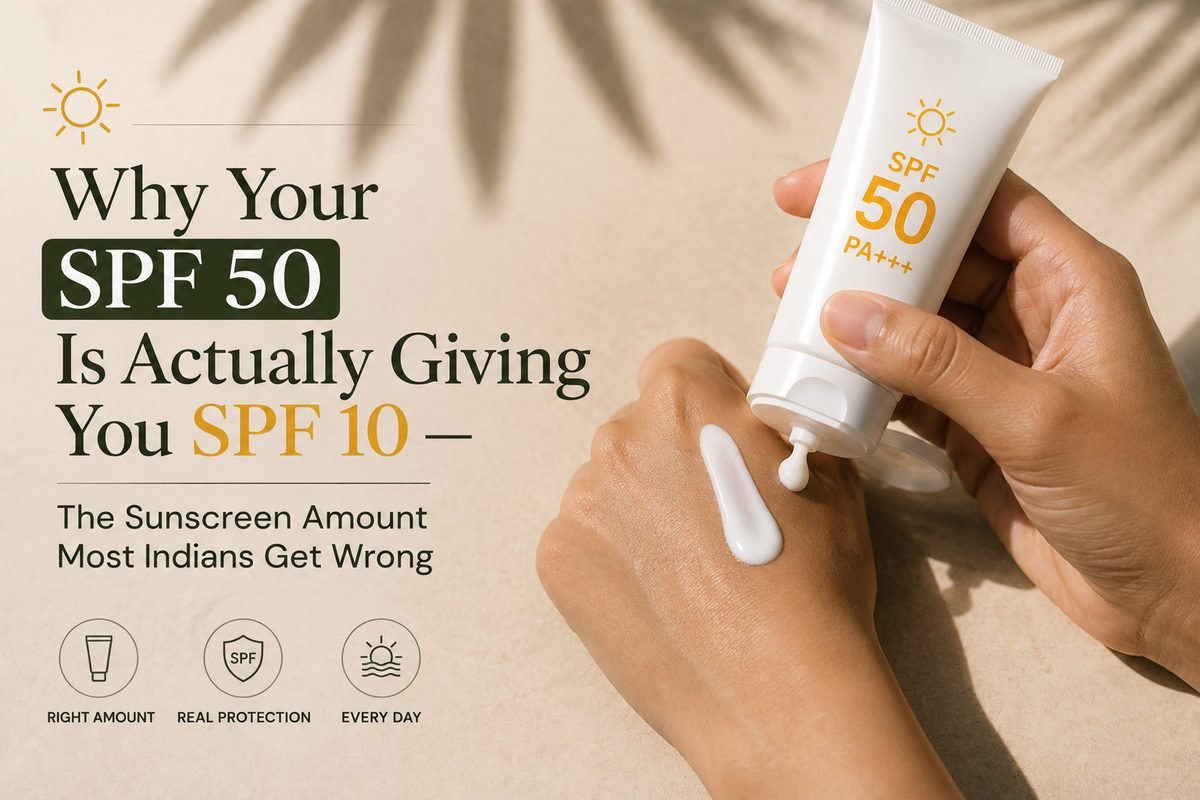
You bought SPF 50. You applied it every morning, not perfectly, but you applied it. You wore it on the commute, at the office, running errands. And somehow, by June, you were noticeably darker. The sunscreen clearly did not work, so you switched brands. Maybe you tried SPF 60 next. Same result. Here is what nobody told you: the brand was almost certainly not the problem. The amount was.
The Math Nobody in Indian Skincare Talks About
SPF does not work the way most people think. When you see SPF 50 on a tube, you assume that if you use a little less, maybe because the product is expensive, maybe because you want to avoid the white cast, maybe just habit, you still get decent protection. SPF 40-something at worst, right?
No. The relationship between application amount and actual SPF received is exponential, not linear. The formula is: effective SPF = applied SPF raised to the power of (actual dose ÷ recommended dose). If you apply half the recommended amount of an SPF 50, the math gives you SPF 50 to the power of 0.5, which is approximately SPF 7.
Seven. From a tube that says fifty.
This is not a scare tactic. This is the actual physics of how UV filters work at the skin surface. The protection percentage does not scale with the product, it collapses. Studies testing this on real people consistently show the same result: at 25 to 50 percent of the recommended dose, which is where most people land by default, you are getting SPF protection in the single digits regardless of what number is printed on your sunscreen.
And yet almost every Indian skincare article about sunscreen says "apply generously" and moves on. Nobody is telling you the actual number.
What the Correct Amount Actually Is
For standardised SPF testing, labs use 2mg of product per square centimetre of skin. That is the benchmark. Everything on the label assumes this dose.
Your face and neck together, the most commonly sunscreened area for most Indians, cover roughly 600 square centimetres. At 2mg per cm², that is 1,200mg of sunscreen. One point two grams. About 1.25ml of product.
Picture a coin. Specifically, a ₹1 coin. That circular puddle of sunscreen sitting on your palm, that is roughly what you need just for your face and neck. Not a dot. Not a pea-sized amount. Not a thin layer that disappears on contact with your skin. A full ₹1 coin worth of sunscreen, applied evenly until there is no product left on the surface.
Most people use somewhere between a third and a half of this. Which, as the math above shows, is the difference between SPF 50 and SPF 7.
There is a simpler field guide: the two-finger rule. Squeeze sunscreen along two full fingers, index and middle, from base to tip on both fingers. That stripe of product, applied to your face and neck, gets you close to the right amount. But there is a problem with this rule that nobody mentions, and it matters specifically for Indian skin.
Why the Two-Finger Rule Has a Problem for Indian Sunscreens
The two-finger rule was originally designed for thick, opaque sunscreen creams, the kind you still find in Western markets, the ones that leave a white cast and feel like you have applied moisturiser twice. Those formulas are dense. Two fingers of a thick cream gets you close to 1.25ml.
Indian sunscreens have moved on from that. The most popular sunscreens in India right now, from brands like Minimalist, The Derma Co, Foxtale, Re'equil, Dot and Key, are lightweight gels, serums and fluid textures specifically designed to feel invisible on Indian skin in Indian heat. They spread faster and thinner. Two fingers of a gel sunscreen dispenses significantly less product by weight than two fingers of a thick cream.
This is not a problem with Indian sunscreens. They work well. The problem is applying a rule designed for thick creams to products that are deliberately thinner and more spreadable.
For lightweight gel or fluid sunscreens, you need to either measure 1.25ml directly, most sunscreen caps are about 1ml, so a slightly generous cap is your benchmark, or err on the side of applying what feels like too much. The texture will absorb. The protection is in the quantity, not the feel.
Use GlowAF's free SPF calculator to find the exact amount needed for your face surface area, it accounts for different sunscreen textures and gives you a specific ml figure rather than a rule of thumb.
Indian Summer Makes All of This Worse
The standard reapplication advice, every two hours, was set in controlled conditions. Indian summer is not controlled conditions.
UV filters degrade with UV exposure. They also wash away with sweat. The more you sweat, the faster your sunscreen loses effectiveness. In Mumbai monsoon heat or Delhi June temperatures, where you can be visibly sweating within fifteen minutes of stepping outside, a 90-minute reapplication schedule is more appropriate than two hours. If you are outdoors doing anything active, walking, running, an auto or two-wheeler commute, sixty minutes.
India also has some of the highest UV indices in Asia. Mumbai and Chennai regularly hit UV index levels above 10, classified as "very high" by WHO, during summer months. Delhi and Agra hit similar levels despite being inland. At UV index 10+, UV rays are damaging unprotected skin in under ten minutes. The sunscreen you applied at 8am before leaving home has been working against serious UV intensity all morning. Reapplication is not optional here.
And here is the competitor gap that almost no Indian skincare content mentions: Bangalore. Despite its reputation for pleasant weather, Bangalore sits at an altitude of around 920 metres above sea level. UV radiation increases by approximately 4 percent for every 300 metres of altitude. Bangalore's UV index during April and May regularly hits levels comparable to Mumbai in peak summer, despite feeling cooler. Bangalore residents tend to be less vigilant about sunscreen because the weather does not feel aggressive, but the UV absolutely is.
The AC Office Myth, Windows Are Not UV Protection
A significant portion of India's working population sits near windows in offices for six to eight hours a day. Most do not apply sunscreen to work indoors. This is understandable, you are not in the sun. But UVA rays, the ones responsible for premature ageing, hyperpigmentation and long-term skin damage, penetrate standard glass without losing much intensity.
UVB rays, the ones that cause sunburn and that SPF specifically measures protection against, are largely blocked by glass. But UVA is a different story. Standard window glass blocks about 37 percent of UVA. That means 63 percent of the UVA radiation hitting your window is reaching your skin, continuously, for hours.
This is why people in predominantly indoor jobs still develop photo-ageing patterns on the side of their face closest to the window. Dark spots on the left cheek from years of sitting by a window. It accumulates slowly and it is cumulative.
Applying a broad-spectrum sunscreen, one with PA+++ or higher, which covers UVA, before a day at an indoor desk near a window is not overkill. It is correct behaviour that most Indian skincare advice does not emphasise because it focuses on outdoor scenarios.
The Melanin Myth, Indian Skin Still Needs Full SPF
There is a persistent belief, sometimes unstated, sometimes explicit, that darker Indian skin tones need less sunscreen because melanin provides natural sun protection. This is partially true and largely used as a justification to skip sunscreen entirely, which is not correct.
Melanin does provide some inherent UV protection. Research estimates that darker skin tones have a natural SPF equivalent of between 7 and 13, depending on depth of pigmentation. That is meaningful. It explains why darker skin tones get sunburned less easily and develop certain types of skin cancer at lower rates.
But SPF 7 to 13 is well below what dermatologists recommend for any skin tone in Indian summer conditions. And while darker Indian skin may be more resistant to sunburn, it is highly prone to post-inflammatory hyperpigmentation, melasma and UV-triggered dark spots, all of which are worsened by inadequate sun protection. The consequences of under-applying sunscreen on Indian skin are not sunburn. They are the kind of pigmentation issues that take months of actives and constant SPF to address.
Full-dose SPF 50 PA++++ for Indian skin is not a Western product recommendation awkwardly transplanted to India. It is specifically appropriate for Indian skin concerns in Indian conditions.
Check Your Actual SPF with GlowAF's Calculator
How much sunscreen do you actually need for your face? The exact answer depends on the surface area of your face, the texture of your sunscreen, how long you are spending outdoors and how much you are sweating. These variables are easy to calculate but nobody does the calculation.
GlowAF's free SPF calculator at glowaf.online/spf-calculator.html does it for you. Enter your details, face size, sunscreen SPF, time outdoors, activity level, and it gives you the exact amount of product you need per application and how often you need to reapply in Indian conditions. It is built around the 2mg/cm² standard and adjusted for Indian UV index levels rather than generic global recommendations.
It takes thirty seconds and the answer is usually slightly more than what you have been applying.
The person who bought SPF 50, applied it properly and still got tanned did not buy the wrong sunscreen. They almost certainly used about a quarter of the amount they needed. The number on the tube means nothing without the right quantity on your face.
Key Takeaways
- SPF protection drops exponentially with under-application, applying half the required amount gives roughly SPF 7 from an SPF 50, not SPF 25
- The correct amount for face and neck is 1.25ml, about the size of a ₹1 coin, significantly more than most people use
- The two-finger rule was designed for thick Western sunscreen creams, popular lightweight Indian gel and serum sunscreens require careful measurement because they spread thinner
- Indian summer sweat breaks down sunscreen faster than the 2-hour standard, reapply every 90 minutes outdoors in peak Indian heat
- UVA rays penetrate glass, working near a window in your Delhi or Mumbai office still causes cumulative skin damage over months
- Use GlowAF's free SPF calculator at glowaf.online/spf-calculator.html to find the exact amount for your skin type and time spent outdoors
Ready to buy?Find out exactly how much sunscreen your skin needs, based on your face size, sunscreen texture, time outdoors and Indian UV conditions.
See Full Guide →